
AUJI Ayurveda blog
Knee Pain After 40: Causes, 5 Simple Exercises and Ayurvedic Care

Last updated: 21 November 2026 · By the AUJI Ayurveda team · General information, not medical advice.
The most common cause of knee pain after 40 is osteoarthritis, a slow wearing of the cartilage that cushions the knee joint. It causes pain when climbing stairs or getting up from a chair, and stiffness in the morning. The good news is that daily exercise, a healthy weight and the right footwear help most people stay active. Medical guidelines recommend exercise as the first treatment for knee osteoarthritis, at every age.
Common causes of knee pain after 40
- Osteoarthritis: pain that builds up over months or years, worse after activity, with stiffness that eases after a few minutes of moving.
- Weak thigh muscles: the quadriceps muscle at the front of the thigh protects the knee. When it is weak, the joint takes more load.
- Extra body weight: research shows that every kilogram you lose takes about 4 kilograms of load off the knee with each step.
- Old injuries: a past ligament or meniscus (cartilage) injury raises the risk of arthritis later.
- Other causes: gout, rheumatoid arthritis, bursitis (swelling of a fluid sac) and pain from the hip or back.
Signs of knee osteoarthritis
- Pain when climbing stairs, squatting or getting up from the floor
- Stiffness in the morning or after sitting, which eases within about 30 minutes
- A grinding or cracking feeling when you bend the knee
- Mild swelling after a busy day
- Bowing of the legs in long-standing cases
When to see a doctor
See a doctor straight away if you have:
- A hot, red, very swollen knee, especially with fever (it may be an infection)
- A knee that suddenly gives way, locks, or cannot take weight after an injury
- Severe pain at night, or pain with weight loss you cannot explain
- Pain and swelling in many joints, or morning stiffness lasting more than an hour (signs of inflammatory arthritis)
For pain that lasts more than a few weeks, an orthopaedic doctor or physiotherapist can examine the knee and, if needed, ask for an X-ray.
5 simple exercises for knee pain
Do these slowly, once or twice a day. Mild discomfort is fine. Stop if pain gets sharp or the knee swells afterwards, and check with your doctor or physiotherapist before starting if you have had knee surgery.
- Quadriceps squeeze: sit with your leg straight. Press the back of the knee down into the floor or bed and tighten the thigh muscle. Hold 5 seconds, relax. Repeat 10 times on each leg.
- Straight leg raise: lie on your back with one knee bent. Keep the other leg straight and lift it about a foot off the floor. Hold 3–5 seconds, lower slowly. Repeat 10 times on each leg.
- Heel slides: lie on your back. Slowly slide one heel towards you to bend the knee as far as is comfortable, then slide it back. Repeat 10 times on each leg.
- Sit to stand: sit on a firm chair. Stand up without using your hands if you can, then sit down slowly. Repeat 10 times. Use the armrests at first if needed.
- Calf raises: stand holding a wall or table. Rise up on your toes, hold 2 seconds, lower slowly. Repeat 10–15 times.
Add a daily walk on flat ground and build up to 30 minutes. Cycling and swimming are also gentle on the knees.
Daily habits that protect your knees
- Keep moving: rest during a flare is fine, but long rest makes the muscles weaker and the knee stiffer.
- Lose a little weight if you are overweight. Even 5% of your body weight makes a difference to pain.
- Choose good footwear: cushioned shoes with a low heel.
- Avoid sitting cross-legged or squatting for long during a flare. Use a chair and a western toilet if the knee hurts.
- Use the rail on stairs and go up with the stronger leg first.
- Heat or cold: a warm compress eases stiffness. An ice pack wrapped in a cloth for 10–15 minutes helps after activity if the knee swells.
The Ayurvedic view of knee pain
In Ayurveda, age-related joint pain is described as Sandhivata, a condition of Vata dosha settling in the joints. It becomes more common as Vata naturally rises with age. Traditional care includes warm oil massage (abhyanga), warm compresses, gentle movement and yoga, warm and nourishing food, and herbs such as Shallaki (Boswellia), Guggul, Ashwagandha, Nirgundi and turmeric.
Some clinical studies suggest that Boswellia and turmeric (curcumin) extracts may give small improvements in pain from knee osteoarthritis, but the research is still limited. Ayurvedic care works best alongside exercise and a doctor's advice.
Where AUJI JointX fits
AUJI makes two Ayurvedic products for everyday joint comfort, both made under AYUSH licence GA/1455:
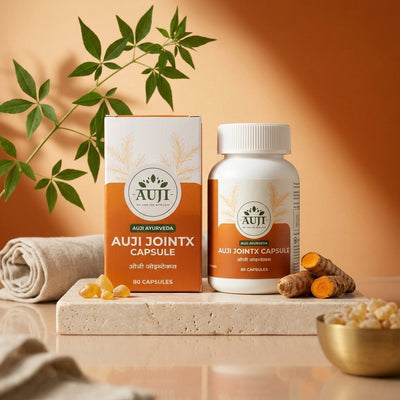
- AUJI JointX Capsules with Shallaki (Boswellia), Guggul, Rasna, Nirgundi, Ashwagandha and turmeric.
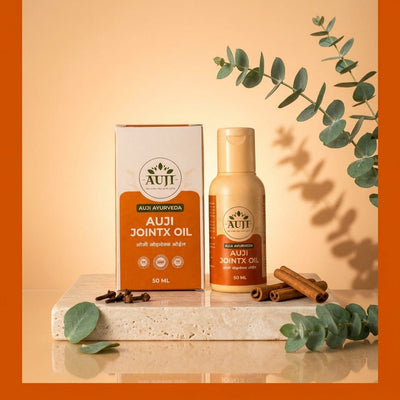
- AUJI JointX Oil, a warming massage oil with Mahanarayan oil, Nirgundi, wintergreen and eucalyptus in a mustard oil base. Massage a little 1–2 times a day. For external use only, not on broken skin.
They do not replace a doctor's treatment. Results vary from person to person. Our Ayurvedic doctor can advise you on WhatsApp, free of charge.
Frequently asked questions
Is walking good for knee pain?
Yes. Regular walking on flat ground strengthens the muscles around the knee and helps the cartilage stay healthy. Start with short walks and build up slowly.
Should I rest a painful knee?
Rest for a day or two during a flare, but not for long. Too much rest makes the muscles weaker, which makes pain worse over time.
Does oil massage help knee pain?
Many people find a warm oil massage soothing for stiff joints. It is a traditional part of Ayurvedic joint care. Massage gently, and do not massage a knee that is hot, red or very swollen.
Can knee osteoarthritis be reversed?
Worn cartilage does not grow back, but pain and movement can improve a lot with exercise, weight loss and the right care. Many people delay or avoid surgery this way.
Sources
- National Institute for Health and Care Excellence (NICE). Osteoarthritis in over 16s: diagnosis and management (NG226), 2022.
- Messier SP et al. Weight loss reduces knee-joint loads in overweight and obese older adults with knee osteoarthritis. Arthritis & Rheumatism, 2005.
- Cameron M, Chrubasik S. Oral herbal therapies for treating osteoarthritis. Cochrane Database of Systematic Reviews, 2014.
This article is general information, not medical advice. Results may vary. Consult a doctor before use.
Related AUJI products
Keep reading
-
Lower Back Pain: Common Causes, 5 Gentle Exercises and Warning Signs
Read the article: Lower Back Pain: Common Causes, 5 Gentle Exercises and Warning Signs -

Why Joints Hurt More in Winter, and 10 Ways to Ease the Stiffness
Read the article: Why Joints Hurt More in Winter, and 10 Ways to Ease the Stiffness -

Ear Infection in Adults: Symptoms, Causes, Treatment and When to See a Doctor
Read the article: Ear Infection in Adults: Symptoms, Causes, Treatment and When to See a Doctor


