
AUJI Ayurveda blog
Piles (Haemorrhoids): Symptoms, Grades, Causes and Treatment Options

Last updated: 21 November 2026 · By the AUJI Ayurveda team · General information, not medical advice.
Piles (haemorrhoids) are swollen veins in and around the back passage (anus). They are very common. Around half of adults have them by the age of 50, according to the US National Institute of Diabetes and Digestive and Kidney Diseases. Most piles get better with simple changes: more fibre and water, and less straining on the toilet. Bleeding should still be checked by a doctor once, to rule out other causes.
Internal and external piles
There are two main types, and they feel quite different:
- Internal piles are inside the back passage. They are usually painless. The most common sign is bright red blood on the toilet paper or in the pan after passing stool.
- External piles are under the skin around the anus. They can itch, swell and hurt, especially when sitting. If a clot forms inside one, it becomes a hard, very painful lump (a thrombosed pile).
The four grades of internal piles
Doctors grade internal piles by how far they come out:
- Grade 1: stay inside. May bleed, but you cannot feel them.
- Grade 2: come out when you pass stool, then go back in on their own.
- Grade 3: come out and you have to push them back in with a finger.
- Grade 4: stay outside and cannot be pushed back.
Grades 1 and 2 usually settle with diet and home care. Grades 3 and 4 more often need a procedure, so see a doctor.
Common symptoms
- Bright red blood after passing stool
- Itching or irritation around the anus
- A soft lump that comes out of the back passage
- A feeling that you have not fully emptied your bowels
- Mucus on underwear or toilet paper
- Pain or discomfort when sitting (mostly with external piles)
What causes piles?
Anything that raises pressure in the lower belly and back passage for a long time can cause piles:
- Constipation and straining: the most common cause. Hard stools make you push harder.
- Sitting on the toilet for long: scrolling the phone on the toilet is a modern habit that keeps pressure on the veins.
- Low-fibre diet and too little water: white rice, maida, fried snacks and little fruit or vegetables.
- Sitting most of the day: long office hours, driving or shop work.
- Pregnancy: the growing baby presses on the veins, and constipation is common.
- Heavy lifting and long-term cough.
- Getting older: the tissue that supports the veins becomes weaker.
When to see a doctor
See a doctor if you have bleeding from the back passage for the first time, even if you think it is piles. Go soon if you have:
- Bleeding with a change in your bowel habit that lasts more than a few weeks
- Dark red or black stools, or blood mixed into the stool
- Weight loss you cannot explain, or tiredness and breathlessness (signs of anaemia)
- A family history of bowel cancer, or you are over 50 and have never had a bowel check
- Severe pain, a hard lump, fever or pus
- Heavy bleeding that does not stop. This needs emergency care.
Piles and bowel cancer can both cause bleeding. A simple examination tells them apart, so do not feel shy about it. Doctors see piles every day.
Home care that helps most
- Eat more fibre: aim for about 25–30 grams a day from vegetables, fruit, dal, whole grains and seeds. Psyllium husk (isabgol) in water is a simple way to add fibre. Increase slowly to avoid gas.
- Drink enough water: fibre works only with enough fluid. Most adults need 8–10 glasses a day, more in summer.
- Do not strain, and do not sit long: go when you feel the urge, and get up after 3–5 minutes. Leave the phone outside.
- Raise your feet: resting your feet on a small stool (or sitting Indian style) straightens the passage and makes emptying easier.
- Warm sitz bath: sit in a tub of plain warm water for 10–15 minutes, 2–3 times a day, especially after passing stool. It eases pain and itching.
- Keep the area clean and dry: wash with plain water and pat dry. Avoid scented soaps and wipes.
- Move every day: a 30-minute walk helps the bowels work regularly.
Want a full food list? Read our diet guide for piles and constipation.
Medical treatment options
If home care is not enough, a doctor (general surgeon or proctologist) may suggest:
- Creams or suppositories to ease pain, itching and swelling for a short time.
- Rubber band ligation: a small band is placed around an internal pile, which then falls off within about a week. It is done in the clinic.
- Sclerotherapy (an injection) or infrared coagulation for smaller piles.
- Surgery (haemorrhoidectomy, stapler or laser procedures) for large grade 3–4 piles or piles that keep coming back.
The Ayurvedic view of piles
In Ayurveda, piles are called Arsha. Classical texts link them to weak digestion (mandagni) and constipation, which disturb Vata and lead to swelling of the veins. Care focuses on regular bowel habits, warm and easy-to-digest food, buttermilk, enough water and gentle herbs that support digestion. Herbs often used in Ayurvedic piles care include Haritaki, Amla, Daruharidra, Neem and Nagkeshar.
Ayurveda also describes procedures for more advanced cases. Ayurvedic care should go alongside a doctor's check, especially if you have bleeding.
Where AUJI Pilex fits
AUJI makes three Ayurvedic products for everyday piles care, all made under AYUSH licence GA/1455:
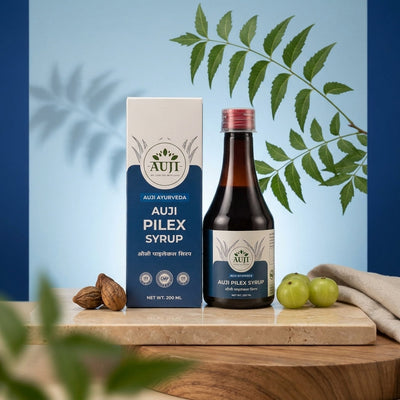
- AUJI Pilex Syrup with Haritaki, Amla, Daruharidra and Neem, to support digestion and regular bowel movement.
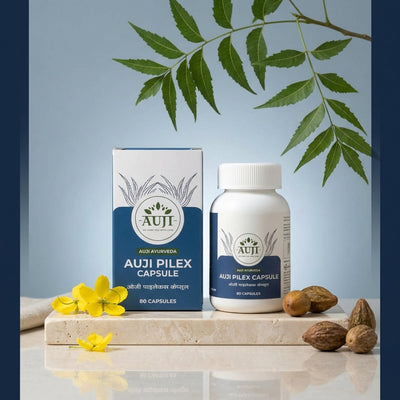
- AUJI Pilex Capsules with Arshkuthar Ras, Daruharidra, Haritaki and Nagkeshar.
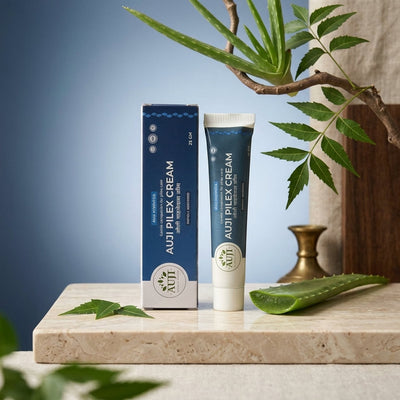
- AUJI Pilex Cream with aloe vera, neem and karanj, with an applicator, for itching and burning.
They do not replace a doctor's treatment. Not recommended during pregnancy unless your doctor advises it. Results vary from person to person. Not sure which one suits you? Our Ayurvedic doctor can advise you on WhatsApp, free of charge.
Frequently asked questions
Can piles go away on their own?
Yes, small piles often settle within a few days to weeks once constipation is fixed and you stop straining. Larger piles that come out may need a procedure.
Is bleeding from piles dangerous?
Bleeding from piles is usually small and bright red. But bleeding can also come from other problems, including bowel cancer, so get it checked once by a doctor.
Which foods make piles worse?
Low-fibre foods like maida, white bread and fried snacks, too much tea or coffee, alcohol and very spicy food can make constipation and irritation worse for many people.
Are piles and fissure the same?
No. A fissure is a small tear in the skin of the anus and causes sharp pain while passing stool. Read how to tell piles, fissure and fistula apart.
Sources
- National Institute of Diabetes and Digestive and Kidney Diseases (NIDDK). Hemorrhoids: symptoms, causes, treatment.
- Hawkins AT et al. The American Society of Colon and Rectal Surgeons Clinical Practice Guidelines for the Management of Hemorrhoids. Diseases of the Colon & Rectum, 2024.
- NHS. Piles (haemorrhoids).
This article is general information, not medical advice. Results may vary. Consult a doctor before use.
Keep reading
-
Lower Back Pain: Common Causes, 5 Gentle Exercises and Warning Signs
Read the article: Lower Back Pain: Common Causes, 5 Gentle Exercises and Warning Signs -

Why Joints Hurt More in Winter, and 10 Ways to Ease the Stiffness
Read the article: Why Joints Hurt More in Winter, and 10 Ways to Ease the Stiffness -

Ear Infection in Adults: Symptoms, Causes, Treatment and When to See a Doctor
Read the article: Ear Infection in Adults: Symptoms, Causes, Treatment and When to See a Doctor


